

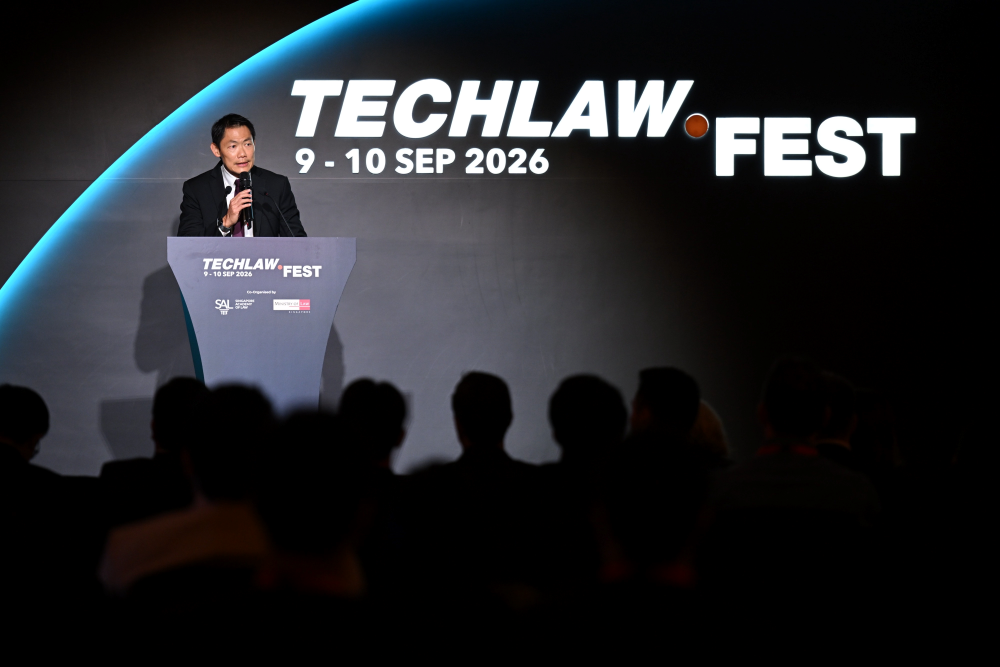
Speech by The Honourable Justice Kewk Mean Luck at TechLaw.Fest 2026

TechLaw.Fest 2026
Welcome Remarks
Tuesday, 10 September 2026
Justice Kewk Mean Luck
Supreme Court of Singapore
Ms Sarah Sackman KC, Minister of State
Ministry of Justice of the United Kingdom,
Honourable Justices,
Distinguished guests,
Ladies and gentlemen,
1. A very good morning, and welcome to Day Two of TechLaw.Fest 2026.
2. Last year, we marked an important milestone with the launch of LawNet 4.0. It introduced a redesigned interface, a single search bar that supports both keyword and natural-language searches, and an AI-powered Q&A search function grounded in LawNet’s legal content.
3. When we first introduced the Generative AI-powered Q&A function, we tuned it for contract law. However, our subscribers have been using it for all
areas of law.
4. Since then, we have tested and
evaluated the Q&A function beyond contract law. We have found that it performs equally well across
other areas of law. To support this work, we developed a structured evaluation
framework, and documented this in a published paper, which is available on the SAL website. We also carried out an
independent safety assessment using the Information
Media Development Authority AI Verify framework, to help ensure that the system
meets appropriate standards of trust and reliability.
5. I am therefore pleased to share that LawNet’s Q&A function is
available for all areas of Singapore law. I would strongly encourage you to try
it and use it. At the same time, our efforts to improve the Q&A function
will continue. Through the evaluation framework, we have identified areas for further
enhancement, such as improving the system for retrieving relevant information
to generate responses. By grounding our efforts in objective data, we can
better focus our attention and resources on the areas that will deliver the
greatest impact for our users.
6. Beyond developing new
capabilities within LawNet, we are working to make trusted LawNet judgment
content, accessible more seamlessly through other LegalTech tools that lawyers
use in their daily practice.
7. To facilitate this, we will work with selected legal technology
partners to pilot LawNet’s Partner Application Programme Interface (the “API”).
The API will enable these partners to integrate LawNet judgment content into
their platforms, offering their users who have active LawNet subscriptions,
access to new or enhanced tools to support their legal research needs. We look
forward to growing this partnership ecosystem over time.
8. Last year, SAL partnered with four international content providers
to make Singapore legal materials more widely accessible. These partnerships
enable Singapore firms to access both international and Singapore legal content
more seamlessly, while making it easier for users in other jurisdictions to
discover and use Singapore legal resources.
9. Together, these initiatives
reflect a broader strategy, to make Singapore legal content available through
the platforms where legal professionals work.
10. The same approach underpins a
new collaboration that will bring SAL’s trusted corporate legal content
directly into tools and workflows used by corporate lawyers and in-house
counsel.
11. I am pleased to announce that
SAL is partnering with LegalOn Technologies, Inc. (“LegalOn”), in
this regard. Under this partnership, SAL’s Corporate References, comprising the
SAL Clause Bank, Commercial Precedents, Guides and Toolkits, will be integrated
into LegalOn’s AI-powered legal platform.
12. This will give LegalOn subscribers more seamless access to trusted
Singapore legal content. They will be able to search, retrieve and generate
AI-powered responses based on SAL’s content, with clear attribution to SAL as
the authoritative source.
13. This partnership strengthens
both organisations’ offerings in the AI-enabled legal services market, while
advancing SAL’s mission to extend the reach and influence of Singapore law
beyond our shores.
14. I had also announced last year, that we have expanded AI-generated
summaries for unreported judgments and began developing AI-assisted tools to
support the research of legislation starting with the Companies Act.
15. These initiatives reflect our
commitment to ensure that LawNet evolves alongside the way lawyers work. As
technology reshapes legal practice, SAL will seek to make legal research more
connected, intuitive and efficient, while preserving what matters most for
lawyers: access to trusted and authoritative sources.
16. Today, I am happy to share
several developments that advance this objective. Together,
they bring materials that practitioners have traditionally accessed separately,
into a more integrated research experience, allowing them to move more
seamlessly between sources of authority and find the
information that they need more efficiently.
Academy Library 2.0
17. An important part of this effort is helping users move more easily between legal commentary and primary sources. To support this, we have been working to integrate the Academy Library more closely with LawNet.18. The Academy Library now brings together 79 Academy Publishing titles on Singapore law, in a seamless and interactive digital format.
19. Users can search within any book in their library to pinpoint key terms, navigate between chapters through the table of contents and view cited references side-by-side.
20. Since July this year, users have also been able to select and download the pages they need.
21. Importantly, the pagination of downloaded PDF corresponds to the print edition. This makes citation more accurate and simplifies the preparation of bundles of authorities and written submissions.
22. I am pleased to announce that Academy Publishing books will now be included alongside case law and legislation in both LawNet’s Classic Search and AI-powered Q&A search. This will enable users to search across these sources more easily and move seamlessly between commentary and the underlying legal authorities.
23. This integration will also allow users to move directly from a discussion in a textbook to the relevant case or statutory provision on LawNet, without interrupting their research flow.
Expanding legislation coverage
24. SAL is also making it easier for users to move between legislation and the cases that interpret and apply it. At last year’s TechLaw.Fest, we introduced LawNet’s enhanced Legislation module, beginning with the Companies Act.25. For example, when users navigate to section 157 of the Companies Act, they can view a list of cases tagged to that specific provision alongside the statutory text.
26. In June this year, we expanded this feature to cover the Rules of Court 2021 and the Supreme Court of Judicature Act.
27. Today, I am pleased to announce we will extend this feature to seven additional pieces of legislation that have the highest volume of related cases based on our tagging system:
- the Penal Code;
- the Rules of Court 2014;
- the Women’s Charter;
- the Misuse of Drugs Act;
- the Evidence Act;
- the Criminal Procedure Code; and
- the Road Traffic Act.
29. This will help LawNet users locate cases relevant to specific statutory provisions more quickly, supporting more efficient and thorough legal research.
Introducing AI-Generated Annotations to Legislation
30. Finding relevant cases, however, is only part of the statutory research process. We recognise that a key challenge in statutory research is identifying the legal principles that are relevant to the interpretation of a particular provision.31. To address this, we have been developing the AI-generated annotated statute feature, beginning with the Companies Act, which was previewed last year. Today, I am pleased to officially launch it for all LawNet users. It enables users to view extracted legal principles relevant to a particular statutory provision, helping them identify the materials most relevant to their research.
32. We intend to roll out AI-generated Annotations for other Acts over time.
33. I am also pleased to share that we have filed a provisional patent application with the Intellectual Property Office of Singapore for the internally developed methodology used to generate these AI annotations. Designed to be scalable beyond the Companies Act, we intend to use the methodology to create AI-annotations for other Acts of Parliament and subsidiary legislation in the future.
A More Efficient, Integrated Approach to Sentencing Research
34. SAL is also looking at ways to improve specialised research workflows in particular areas of practice.35. One example is sentencing research. Sentencing research often requires practitioners to refer to several different sources of information, including statutory provisions, cases, sentencing guidelines, and statistical data.
36. When these materials are presented separately, practitioners spend considerable time piecing together a complete picture of how an accused has been sentenced for an offence.
37. The first phase of the revamped Sentencing Information and Research Repository (the “SIR”), which will be launched next year, is designed to make part of this process faster and more intuitive. You can catch a preview of the new SIR at the LawNet booth in the Hibiscus Room.
38. Users will be able to search by legislation and statutory provision, and view sentencing charts, relevant cases, charge listings and appeal records in a single, integrated view.
39. By bringing these materials together, SIR aims to help users identify relevant precedents and sentencing information more efficiently.
Closing
40. For more than 35 years, LawNet has evolved with the profession while remaining a credible and affordable platform for legal research.41. Its purpose, however, has remained constant: to provide a dependable foundation for legal work. This purpose has driven the new improvements in LawNet that I have announced today. These include:
- Generative AI-powered Q&A searches for all areas of Singapore law;
- bringing Academy Publishing titles into LawNet’s search tools;
- expanding legislative coverage to the 10 most frequently cited statutes;
- launching AI-generated annotations to legislation; and
- the first phase of a revamped Sentencing Information and Research Repository.
43. Delivering on this commitment also requires meaningful collaboration across the profession, academia, government agencies and the wider technology community.
44. Yesterday, we saw an example of this in CiteCheck SG, a proof of concept, developed by a team of AI engineers and academic staff from Singapore Polytechnic’s 5G & AIoT Centre to help lawyers efficiently verify the accuracy of case citations in legal documents, through the Hackathon for a Better World: Future-Proofing the Legal Profession, jointly organised by DBS and the Singapore Courts.
45. This afternoon, I encourage you to visit the LawNet Tech Bytes Stage for a closer look at the expanded AI-powered Q&A search, Academy Library 2.0 and new Annotated Statutes feature, as well as how we develop and evaluate our AI tools for accuracy, reliability and user safety.
46. These efforts form part of the ongoing enhancements to LawNet. As lawnet.sg is set to be sunset on 1 December this year, I invite those who have not yet migrated to the new LawNet 4.0 to do so and make full use of these enhanced LawNet capabilities.
47. Many of these improvements have been informed by the time and insights that our users have shared with us. I am very grateful for them. We could not have made these improvements without your suggestions and support.
48. We hope that you will continue to share your feedback, so that LawNet remains not only a comprehensive source of Singapore law, but also a trusted and indispensable tool for our legal profession, in the years ahead.
49. I wish you a fruitful conference and look forward to the insightful discussions ahead. Thank you.