

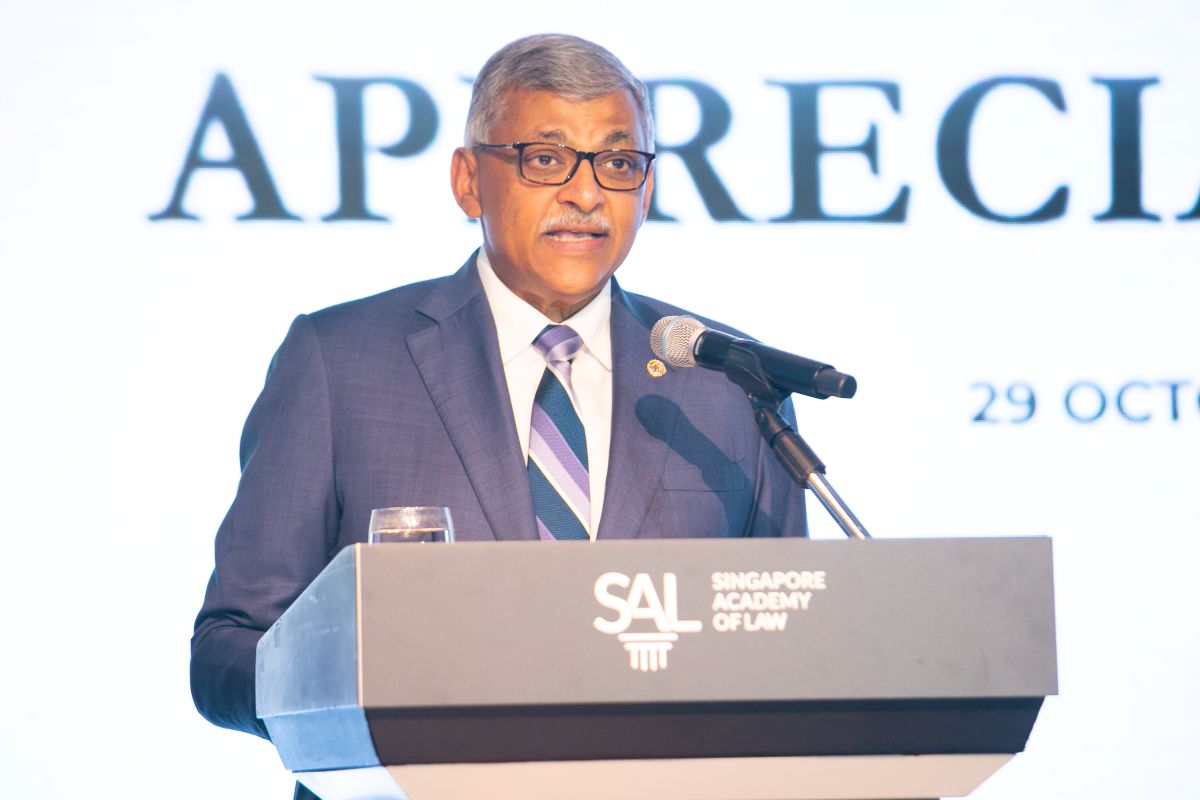
Opening Remarks by The Honourable the Chief Justice Sundaresh Menon at SAL Annual Appreciation Dinner 2026

SAL Annual Appreciation Dinner 2026
Opening Remarks
Thursday, 29 October 2026
The Honourable the Chief Justice Sundaresh Menon
Supreme Court of Singapore
Fellow members of the Academy
Distinguished guests
Ladies and gentlemen
1. A very good evening to all of you. On behalf of the Academy, welcome to our Annual Appreciation Dinner. This is a particularly meaningful occasion for me, as this will be the last occasion on which I will attend and participate at the Appreciation Dinner of the Academy as its President. It has been an immense privilege for me to serve as President of the Academy, and to have done so at a time when the profession has been undergoing unprecedented change and disruption and to have had the chance to play a part, together with our stakeholders, in developing our collective responses to these realities. Tonight, I am really grateful to have the opportunity to look back very briefly on the past 14 years and, more importantly, to thank the many people who have given so generously of themselves to the Academy’s work.
2. In 2018, I delivered the SAL Annual Lecture to mark the Academy’s 30th anniversary. It seemed fitting then to take the Academy itself as my subject and to reflect on its vision and its values. The Academy was founded to bring together the Bench, the Bar, the Legal Service and academia in a shared endeavour to advance the administration of justice. At the heart of that vision has been the values of honour and service, expressed in its motto, honor est in honorante, or “honour is in honouring”.1
3. That founding vision has continued to guide the Academy, even as its work has grown in scope and ambition, and the needs of the profession have changed. This evening, I would like to reflect briefly on three aspects of that work: first, sustaining professional excellence; second, harnessing technological change; and third, serving the wider community.
I. Sustaining professional excellence
4. Let me begin with professional excellence. Since I took office, legal practice has become more demanding. Disputes and transactions have grown in complexity, and lawyers increasingly find themselves having to navigate different legal systems and technical disciplines. At the same time, the market for legal services has become ever more competitive, with clients expecting increasingly sophisticated advice and ever more complex work product all to be delivered within tighter timeframes. And the nature of that competition may itself be changing as AI takes on more routine tasks, shifting the field of competition towards the more complex and high-stakes matters where human judgment will prove decisive. To meet these demands, many lawyers will need to acquire a broader range of capabilities while deepening their expertise in particular fields.
5. The Academy has sought to support the development of these qualities. Through the Junior Lawyers Professional Certification Programme, we have been helping younger lawyers build the foundation for their careers. Through the Specialist Accreditation Scheme, we have recognised lawyers with proven expertise and established a benchmark for excellence. And through the Legal Industry Framework for Training and Education, or LIFTED, we have sought to map the competencies required in different legal roles and provide a more rigorous basis for professional development. We are now extending that framework to allied legal professionals, in recognition of their growing contribution to the delivery of legal services.
6. The demands of modern practice extend beyond legal knowledge and technical skills. This has informed our investment in leadership development through the SAL-INSEAD Legal Leadership Programme and the Legal Leadership Playbook”.2 At the heart of effective leadership is a commitment to developing the next generation of lawyers. That responsibility has become more important at a time when the pressures of practice, and the increasing automation of tasks to which I have referred, are reducing the opportunities available for younger lawyers to develop their craft. This underscores the value of initiatives such as the renewed Advocacy Pledge, which seeks to ensure that junior lawyers receive meaningful opportunities for oral advocacy, backed by proper supervision and feedback.
7. The sustainability of legal practice is closely connected with these concerns. The profession must not only attract capable people, but it must also create the conditions in which they can build fulfilling careers over the long term. The Academy has partnered with various stakeholders to address this need through platforms such as the Legal Profession Symposium and the Future of the Legal Profession Committee. The Committee’s work is jointly steered by the Chief Justice and the Minister for Law, indicating the importance that we place upon this effort. The task of building a sustainable profession cannot rest with any single institution, and I am encouraged by the commitment that I have seen across the profession to find enduring solutions and bring about genuine improvement.
II. Preparing the profession for change
8. The second aspect of the Academy’s work concerns the transformation of the legal sector. Technology, and especially generative AI, is changing not only how individual tasks are performed, but also the economics, organisation and delivery of legal services. Firms will increasingly have to consider how work should be organised and where the distinctive value of the human lawyer lies. The Academy recognised the need to prepare the profession for these types of changes even before the advent of generative AI. In 2017, we launched the Legal Technology Vision as a roadmap for the profession’s digital transformation. Through the Future Law Innovation Programme, we brought lawyers, technologists and entrepreneurs together to devise and test new methods of service delivery.
9. The future of legal services will continue to be shaped by a global exchange of ideas that extends well beyond our shores. Our legal community must remain part of that conversation, not only to learn from developments elsewhere, but also to help shape them. Working with the Ministry of Law, the Academy developed TechLaw.Fest as a major international gathering for the legal technology community, and it has attracted some 26,000 participants across 11 editions.3 Next September, we will build on this momentum by collaborating with Law.com to launch LegalWeek Asia in partnership with TechLaw.Fest. This will combine TechLaw.Fest’s regional network with Law.com’s global presence and expertise to create a focal point for legal technology in Asia.
10. We have complemented these efforts by equipping lawyers with the practical tools and capabilities needed to use technology effectively. LawNet 4.0 now offers AI-powered legal research grounded in authoritative legal materials, with closer integration of case law, legislation and commentaries.4 In collaboration with Microsoft, we developed Prompt Engineering Guides for lawyers and for mediators, and more recently launched AIxLegal by SAL with the support of IMDA to promote the responsible adoption of AI across the profession.5 Taken together, these efforts are intended to equip our profession not just to adopt new technologies, but to make informed choices about how those technologies can effectively and safely be harnessed in the mainstream of legal practice even as that mainstream is being dramatically transformed.
III. Service beyond the profession
11. Finally, let me turn to the Academy’s service to the wider community and the public good. While much of our work is directed towards the legal profession, the Academy has always had a wider responsibility to those whom the law serves. This is reflected, in part, in the public services entrusted to us. Just last month, we enhanced the Wills Registry with the launch of the Wills Repository, which gives families the assurance that they can locate the will of a loved one when the need arises.6 Last year, we introduced electronic Apostilles to make cross-border document authentication more convenient and reliable.
12. The Academy has also drawn on the skills and generosity of the legal community to support those in need. During the pandemic, the Singapore Mediation Centre worked with the Judiciary to mobilise volunteer mediators under the SGUnited Mediation Initiative. At a time of considerable uncertainty, these volunteers helped litigants resolve their disputes without charge. In a similar vein, the Chief Justice’s Cup, which I mooted in 2015, has brought lawyers together on the futsal court for a worthy cause. Over the years, it has raised nearly $1.4 million for the Yellow Ribbon Fund and the Singapore After-Care Association to support ex-offender reintegration into our communities.
13. Our commitment to service also extends beyond Singapore, through the Academy’s efforts to strengthen legal cooperation across the region. Over the past decade, the Asian Business Law Institute (“ABLI”) has progressed from mapping differences between Asian legal systems to developing frameworks to address cross-border challenges and where possible to promote and encourage meaningful convergence of transnational business laws. One significant example is ABLI’s contribution to the ASEAN Framework on Cross-border Cloud Computing project, whose three deliverables were endorsed at the ASEAN Digital Ministers Meeting earlier this year.7
IV. Conclusion
14. I have touched on some of the Academy’s endeavours this evening to make the point that it is an institution that is vital to supporting our legal profession, and also to underscore our commitment as an organisation to doing just that. Even this brief account shows how much of what we have achieved has depended on people willing to devote their time, energy and expertise to something larger than themselves. My heartfelt thanks accordingly go to my colleagues on the Senate and Executive Board; to the members of the Investment Committee, some of whom are not even lawyers but who have helped us steward our resources over the years; to the dedicated members of all our committees and boards; and to our many institutional partners and volunteers. I am especially grateful to the Academy’s staff, whose tireless work and dedication underpin everything that we do.
15. Serving as President of the Academy has been a tremendous privilege. I have greatly valued the opportunity to work alongside so many of you, and to see the Academy’s ideals of honour and service given life through your commitment and contributions. Much of this work will continue beyond my tenure. I have had the opportunity to discuss the Academy’s future priorities with my successor and friend, Justice Sushil Nair, and I am encouraged by our shared sense of the Academy’s role and the work that lies ahead. I know that you all will extend to him the same support that you have given to me.
16. Thank you so very much. I know that we will stay in touch, and I wish you all a most enjoyable evening ahead.
1. Sundaresh Menon CJ, “The Singapore Academy of Law: An Essential Dedication to Honour and Service”, Singapore Academy of Law Annual Lecture 2018 at paras 36–50.
2. Singapore Academy of Law, “Singapore Academy of Law Launches Legal Leadership Playbook, Endorsed by the Human Capital Leadership Institute” (29 April 2026).
3. Singapore Academy of Law, “Singapore Academy of Law Announces LegalWeek Asia Partnership with Law.com to Build Asia’s Flagship Legaltech Conference; Unveils AI-Powered LawNet Upgrades at TechLaw.Fest 2026” (10 September 2026).
4. Singapore Academy of Law, “Singapore Academy of Law Signs Global Content Partnerships to Expand Worldwide Access of Singapore Law and Unveils AI-Powered LawNet 4.0 at TechLaw.Fest 2025” (11 September 2025).
5. Singapore Academy of Law, “AI Fluency Programmes”.
6. Singapore Academy of Law, “SAL Wills Registry Enables Secure Deposit of Digital Copies of Wills” (9 September 2026).
7. Asian Business Law Institute, “ABLI Successfully Completes ASEAN Framework on Cross-Border Cloud Computing Project” (4 February 2026).