

Singapore Academy of Law, Institute for Human Resource Professionals and Singapore Mediation Centre Partner to Support Workforce Redesign for the Legal Sector

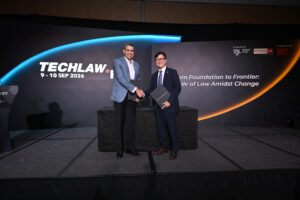
Collaboration will help law firms redesign roles, build HR capability and manage workplace change as AI reshapes legal work
Singapore, 9 September 2026 – The Singapore Academy of Law (the “SAL”), Institute for Human Resource Professionals (the “IHRP”) and Singapore Mediation Centre (the “SMC”) have signed a Memorandum of Understanding (the “MoU”) at TechLaw.Fest 2026 to collaborate on job redesign initiatives for the legal industry. Under the MoU, IHRP will support law firms in redesigning jobs as they adapt to changing workforce needs, with a focus on job redesign, workforce transformation and strengthening HR capabilities. Separately, SAL and SMC will contribute to the HR sector through structured training and workshops on labour policies and legislation, conflict management and dispute resolution.
As AI and other technologies become more embedded in everyday legal work, firms will need to consider how roles, workflows and skills should evolve alongside them. At the Legal Profession Symposium in July this year, Minister for Law (the “MinLaw”) Edwin Tong SC noted that the legal profession will face significant challenges as AI advances rapidly.
This is not a distant reality. The shift is already underway globally. Wolters Kluwer’s 2026 Future Ready Lawyer Survey found that 92 per cent of legal professionals use at least one AI tool in their daily work. More than half of respondents reported saving between 6 per cent and 20 per cent of their work week through these tools.
As routine tasks become increasingly automated, the challenge is no longer about adopting new technologies but rethinking how work is organised around them. While these developments create meaningful opportunities, they can also leave employees uncertain about how their roles, responsibilities and career paths may change. To fully realise the benefits of digitalisation, law firms will need to redesign jobs and workflows, enabling employees to take on higher-value responsibilities and contribute in new ways.
Supporting firms in this transition will require a deliberate, people-centred approach that considers how work, skills and workplace practices evolve alongside technology. This will be critical to building a future-ready and resilient legal workforce.
Inter-Agency Collaboration for Workplace Redesign
The MoU reflects a broader, coordinated effort involving the IHRP and SAL, with partners such as the Skills and Workforce Development Agency (the “SWDA”) and Temasek Polytechnic (the “TP”), to provide law firms with relevant support for digital transformation, human-centered jobs redesign and reskilling.
It complements MinLaw’s Legal Innovation and Future-Readiness Transformation (the “LIFT”) pilot, which provides direct change-management support to help firms identify workflow pain points and adopt appropriate legal technology tools.
MoU Scope
Under the MOU, SAL, SMC and IHRP will work together on these areas:
- Job redesign initiatives for the legal industry. This includes the development of a Job Redesign playbook (the “Playbook”) with partners such as TP and SWDA. Targeted for launch in the first half of 2027, the Playbook will support law firms in their job redesign and reskilling efforts, with a focus on roles such as associates, paralegals, legal secretaries and legal technologists as a start.
- Structured training and workshops. SAL and SMC will provide structured training and workshops on labour policies and legislation, conflict management and dispute resolution. Subject to IHRP’s accreditation process, these programmes may be aligned with relevant competency frameworks and skills-recognition pathways.
Mr Yeong Zee Kin, Chief Executive of the Singapore Academy of Law, said, “Artificial intelligence is reshaping the workforce, and the legal profession is no exception. This collaboration will equip leaders of law practices and legal departments with the capabilities and practical tools to redesign workflows, tasks and job roles within their organisations. By embracing the changes that AI brings and harnessing its benefits responsibly and effectively, lawyers and allied legal professionals can stay ahead of the curve as legal practice evolves. Crucially, this will help the legal profession respond to changing client demands and remain competitive in a global landscape.”
Mr Aslam Sardar, Chief Executive of the Institute for Human Resource Professionals, said, “The future of the legal profession will depend not only on how technology transforms work, but also on how professionals build the capabilities to work effectively in this new environment. This collaboration between key stakeholders creates an opportunity to bring job redesign, skills recognition and capability development together, giving legal professionals clearer pathways to strengthen the skills they need as their roles evolve. By connecting workforce transformation with continuous professional development, we can help build a legal workforce that is adaptable, capable and ready for what comes next.”
This collaboration builds on SAL’s wider efforts to support the legal profession in navigating change, including the Legal Leadership Playbook, launched in April 2026 to help and equip legal leaders with the skills and perspectives to lead change effectively and build future-ready organisations. It is endorsed by the Human Capital Leadership Institute, Asia’s leading centre of excellence for leadership development.
-END-